
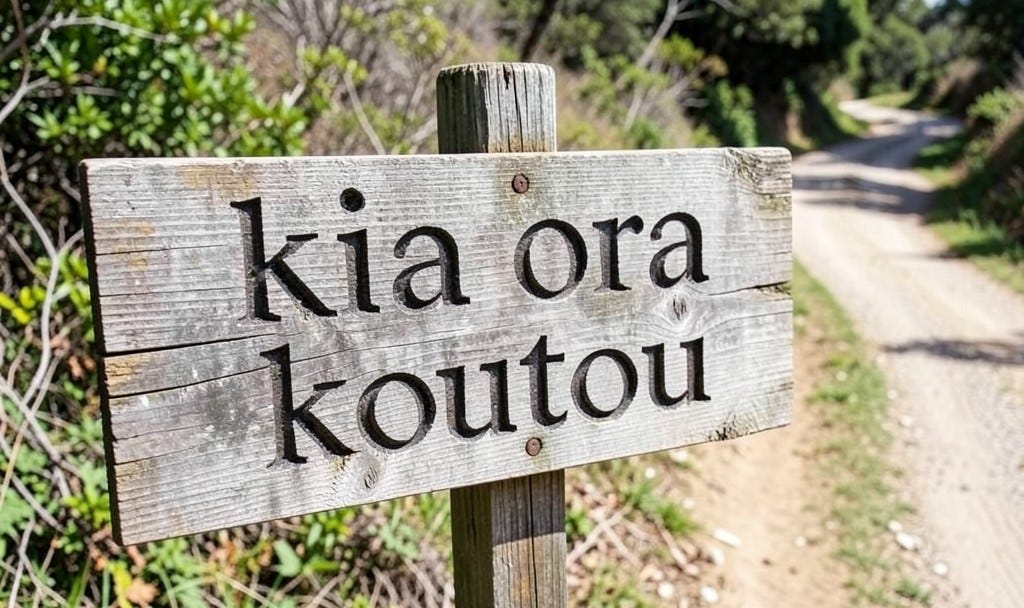
Opening note from Tomas
Greetings from New Zealand.
I want to say how genuinely happy I am to be part of this project. Working with Anicca in this capacity feels very full-circle for me. I encountered the phases framework fairly early in my own experience and it helped me orient to some pretty rocky territory I was moving through. Coming back to that framework now as an editor and curator feels both rewarding and rather unexpected in the best possible way.
I’ve spent the past few weeks working with the portal archive and the outreach from readers that didn’t get published, which has been really fascinating. I look forward to unpacking the many insights it’s yielded. However, I’m most excited about the potential of this new format going forward.
Even though Anicca is no longer answering individual questions from readers, paid subscribers are invited to contribute observations that will help shape future essays and conversations like the one below.
Going forward, the publication will follow a consistent monthly rhythm that will look like this:
In Patterns, we’ll begin with an Editor’s Note from me identifying a developmental structure or theme, and why we’re exploring it. Then Anicca will reveal and unpack the underlying architecture.
In Fault Lines, Anicca takes the central mechanism apart in greater depth.
In Foundations, she examines an enduring principle underlying the work. The Phases, and things like identity, control, surrender, resistance, meaning, attention, or another piece of the developmental terrain.
At the end of the month, Anicca and I return to the themes explored in Conversations. By then, readers have had time to sit with the material, and these conversations becomes a kind of commentary track connecting the essays, clarifying distinctions, and following questions that emerged during the writing.
Ask Anicca will become an ongoing exploration of the dismantling process itself. Drawing from reader submissions, the publication will investigate the common structures, blind spots, and developmental transitions that characterize the movement toward Human Adulthood.
This opening month begins a little differently. Anicca’s Ground Zero piece establishes the publication’s starting point, and the conversation below is our chance to look at the terrain before the standing rhythm begins. Going forward, Patterns will be available to all subscribers, while all other pieces will be reserved for paid subscribers.
Because it’s the first one, this first conversation is available to all subscribers and it’s also a bit longer than they’ll be going forward.
These conversations come from Zoom recordings between Anicca and me. We’re spread across some pretty challenging time zones, so talking live isn’t always the easiest option, but we chose to do it anyway. We wanted a real exchange, not a polished version of one, and the recordings give me solid notes to work from when I put together the transcripts.
For readability, I do some very light editing to trim out repetition, side tracks, and verbal filler, but I’ll keep the natural flow and heart of each conversation intact.
Tomas:
Kia ora, Anicca! It’s great to see you.
Anicca: (nodding, smiling) And you. Greetings from yesterday.
Tomas: (Laughs) Yep, next day over here in Auckland.
Before we jump into the deep end of the pool, can you share a little bit about your experience with the questions portal? What was it like answering individual questions like that?
Anicca: Yeah, sure. It was interesting. When the Ask Anicca portal first launched, there was an expectation from the team, mostly Elaine, that readers could be guided toward asking increasingly authentic questions.
Tomas: You mean real questions as defined in the book?
Anicca: Yes, and in the portal submission process; it’s laid out quite clearly. The expectation was that readers would submit real questions and that my responses could expose assumptions and provide orientation.
Tomas: Was that not your expectation?
Anicca: No. I didn’t really have any expectations to be honest, but I kind of knew it wouldn’t go that way.
Tomas: Why do you say that?
Anicca: Partly based on questions I’ve gotten in person, but also knowing what this type of inquiry requires.
And yeah, as the archive grew, a different picture emerged and portal submissions helped expose an important gap that can now be addressed.
Tomas: Ah, yeah? What was that gap?
Anicca: Well, how to ask a real question is one of the fundamental principles of the book, right along with humanity’s arrested development and authentic Human Adulthood. It is a major pre-req of the radical inquiry required to dismantle the false self. If someone isn’t able to do this one thing, then nothing else matters.
In my writing, I put forth that humanity’s failure to reach existential maturity has positioned us as an aberrant species and propose radical inquiry as a necessary process to reach authentic Human Adulthood.
People seem to understand these things in principle, but radical inquiry is where the rubber hits the road and asking a real question is a hard requirement.
There are endless types of inquiry. But the kind required to dismantle the juvenile self and mature into an authentic human adult cannot be done without asking real questions. Period.
Tomas: (Nodding) We’ve actually gotten a fair amount of outreach from readers sharing that they really want to undergo the kind of radical inquiry you describe in the book but are having a tough time formulating a real question. And also from people who were eager to ask a question but they didn’t know if it qualified as a real question.
Anicca: Yeah, that’s the gap. It starts there. Until you can formulate a real question none of this moves from theory to practice. Period. What looks like dreamstate sorcery keeping one bound is really just one’s inability to do that one thing.
Tomas: Yeah, I see what you’re saying. The book defines a real question as one that costs the asker something. It threatens the structures used to maintain identity, turns inward, exposes rather than defends, and risks actual change.
And you point out that, by contrast, most ordinary questions seek relief, explanation, orientation, reassurance, or a better method.
A: Yes, they preserve the questioner while appearing to investigate the problem. That’s overwhelmingly what we saw in the portal.
Almost nobody asked a real question.
They asked all kinds of questions about which phase they’re in, whether they should quit something, whether their experience is normal, whether they can preserve a relationship. Or they want to know how to distinguish dismantling from pathology.
The circumstances differ a lot, but the underlying question remains remarkably stable. How can I undergo this process without losing the thing I am using the process to protect?
Tomas: (Nodding) You say, almost nobody asked a real question - can you give an example of a real question that was asked?
Anicca: Yeah, one that comes to mind is: What am I still protecting by continuing to question?
Tomas: Oh yeah, I remember that one. And you said it’s vital to not let the questioner become a new identity that needs killing…
Anicca: Right, I think I used the term, The Clubber. (Laughs)
Tomas: Yep! Can you explain what makes that a “real” question in this context?
Anicca: That question is “real” because it turns the inquiry back onto the asker’s own avoidance instead of chasing more concepts, and it directly threatens the very thing doing the asking. It targets the obstruction, not the answer and it exposes the use of inquiry as a possible shield. It’s basically asking: Maybe my endless questioning is itself a protection racket. What part of me refuses to let this inquiry become dangerous enough to matter?
Tomas: Why do you think it’s so challenging for people to ask a real question?
Anicca: Short answer is that the false self is a brilliantly designed avoidance machine, and a real question is the one thing it can’t survive. They risk everything the dreamstate has taught you to value - your story, your identity, your sense of meaning and safety.
Tomas: So you think it’s a fear thing?
Anicca: It’s always a fear thing. Fear is the dominant emotional driver in humans. And the portal submissions mostly showed fear of loss. Loss of control, loss of meaning, loss of relationships, loss of stability, loss of identity. And mostly the mother of all fear: annihilation.
Tomas: Yeah, I can see that. So you’ve got this fear-driven survival machine fighting for its survival by throwing on the costume of the Dismantler?
Anicca: (Laughs) Yeah, you got it! Never underestimate the cunningness of the juvenile self and the power of the collective dreamstate.
Tomas: Amen. It’d be hard to overemphasize the impact those two things hold over the dismantling process. I also think that the inability for most readers to ask a “real” question may be some of the strongest evidence for the book’s central claim.
Anicca: Yeah, you could be right about that.

Tomas: Okay, movin’ on. As you know, I’ve spent a solid chunk of time with the individual questions in the portal archive. People asking about a job, a relationship, guilt, depression, surrender, meaning, therapy, or whether they were in a particular phase.
But read together rather than separately, the circumstances begin to recede and the same structures appear again and again.
Anicca: Yeah, I don’t see the archive as a collection of personal dilemmas, but as evidence of a shared developmental architecture.
Tomas: Yes! When we stop viewing each submission as an isolated issue, the apparent uniqueness of each story begins to fall away and the shared structure underneath becomes visible. Recurring expressions of the same developmental tensions around control, identity, safety, and loss.
Anicca: Well-said. Yes, that shared structure is a big finding. And exciting, because that shift makes several things possible: we can distinguish symptoms from structure, recognize where readers are at developmentally, and identify the assumptions keeping them stuck.
Tomas: Right. And it also turns the archive into something larger than a collection of questions. It’s more like a snapshot of how arrested development behaves when its organizing structures begin to fail.
What other opportunities do you see with this new publication?
Anicca: The greatest opportunity I see is a living investigation of how the dismantling of the juvenile self is actually experienced.
The Phases of Jumpers outlined in the book offer readers a map of the broader territory. This publication can show what repeatedly happens within that territory. How people bargain with surrender, try to preserve identity, confuse destabilization with failure, or turn dismantling into another project of self-improvement.
So yes, as you’ve alluded to, by reading submissions together , we can reveal the shared architecture common to all.
Tomas: Yeah, I think that’s pretty exciting! There’s also an important research opportunity. Because the publication will evolve through reader submissions, it can refine distinctions that the book could only establish provisionally, you know? We can identify new patterns, and track how familiar defenses change over time.
So, the potential here becomes not just commentary on the book, but an accumulating record of what happens when people encounter its framework and attempt to live with what it exposes.
Anicca: Yes, exactly. I think for readers, that creates both orientation and recognition. There’s an opportunity to see that what feels uniquely personal is really part of a recurring developmental structure. That could help one become more precise about what they’re protecting, resisting, or misunderstanding. The aim is not to categorize people or solve their problems, but to make the underlying movement increasingly difficult to avoid.
Tomas: That’s huge! I certainly could’ve used something like this when I was wandering the existential desert all those months!
So, over time, this publication could become a living anatomy of the movement toward authentic Human Adulthood. Not a static doctrine, but a continually tested and clarified account of the territory.
Anicca: Rock n’ roll. (smiling)
Tomas: I’m so happy to be part of this, Anicca. This is the type of project I could never have seen coming but it’s like I was built for it. (Laughs.)
Anicca: (Nodding) I’m glad you’re here, Tomas. And you also have a fair amount of lived recognition, which is also really useful.

Tomas: Okay, so, another dominant observation is that most readers weren’t really asking the question they thought they were asking.
The surface questions varied a lot. Things like, should I leave my job? Why does my partner not understand? Am I depressed or dismantling? How do I surrender? What phase am I in? Does truth exist? Does nothing matter? Why am I being targeted?
But underneath there was a much smaller number of recurring questions. Basically, am I breaking, or is something real happening? Can I survive if this identity collapses? Can I dismantle without losing everything I value? Can I control the process?
Anicca: Yeah, again fear and survival are prominent. Those are all some form of Is there a way to surrender without actually surrendering?
Tomas: (Nodding.) Yep, yep. So, phase-wise, the archive suggests that many readers cluster around Disruption and early Deconstruction.
They appear to be at a place where the old organizing structures are failing, but surrender hasn’t yet happened and a new orientation hasn’t stabilized.
Anicca: Yeah, I picked up on this as well. Many - probably most - are at a threshold where life is starting to feel fraudulent or uninhabitable but they’re not yet really seeing the one who wants to repair, or manage, or accelerate, or explain what’s happening.
Tomas: Right. Why is that threshold so frightening? Given how prominent fear of loss is in the questions themselves, what is someone actually losing at this stage?
Anicca: Oh god, everything that matters to them, really. At this stage, they’re watching the old maps fall apart; the ones that used to say who they were, what mattered, and how to decode experience. It’s the collapse of certainty. This shit doesn’t go down easy.
Tomas: (laughs) No, it doesn’t!
I think a framework like the Phases can be really useful at this stage. In my case, it helped to recognize that things like the loss of meaning, identity, and stability have a discernible developmental structure.
I also think it made the experience less likely to be mistaken for personal failure.
Anicca: Yeah, the map doesn’t remove the uncertainty, but it can clarify the territory. It doesn’t pretend to provide a method or timetable, but hopefully it offers orientation.
Tomas: Yes, exactly.
Okay, so, you chose to begin the publication with the phrase Ground Zero, which has so many meanings. What did you mean when you said oceanside has always been ground zero for you energetically?
Anicca: (sighs) It’s hard to talk about this stuff without sounding woo-woo, but it’s just my operating reality. It’s a flow v obstruction thing. Bodies are energetic systems that can be balanced or blocked, like any circuit or network. For me, oceanside environments are particularly effective at dissolving energetic obstructions and restoring coherent flow states. If you wanna look at why, I suppose they provide some combination of grounding, regulation, and sensory coherence that supports biofield organization.
Tomas: Biofield? As in biophysics?
Anicca: Yeah, some areas of biophysics describe a biofield as the field of energy and information that surrounds and permeates a living organism, helping to regulate its health, self‑organization, and responses to stress, etc.. It’s just the scientific or umbrella name for what’s sometimes called the aura, life force, or subtle energy field.
Bottom line though, when the nervous system is regulated, subtle energy comes back into coherence.
And for me, being near the ocean acts like a big energetic tuner.
Tomas: Makes sense, thank you! I think I’ve experienced what you’re describing…
Anicca: I think everyone has at some point. It’s one of those things that’s there to be seen, you know? Comes into focus when not obscured.
Tomas: Wow, yeah, thank you.
Before we wrap up, a quick reminder to paid subscribers to submit a Field Report where they can share responses and questions that help shape future essays and Conversations.
The first one is up now, and I anticipate doing more throughout the year.
Thanks, Anicca. This is all really exciting. And you’ll be exploring the things we’ve discussed in more depth soon with the first Patterns and Fault Lines publications, yes?
Anicca: Yeah. And we should probably also acknowledge that turning the dismantling of the juvenile self into a neat four-week editorial calendar contains at least a small amount of cosmic comedy.
Tomas: (Laughs) Yes! You mentioned this when we spoke last week. That’s the rub, isn’t it? The publication must use the organizing tools of the dreamstate to investigate the failure of those very tools.
Anicca: Yeah, it’s absurd, but usefully so. The structure doesn’t tame the process; but it gives us a recurring place to observe the fires as they burn.
Tomas: Huge thanks to everyone joining us here at the beginning.
We’ll see you next week.
