
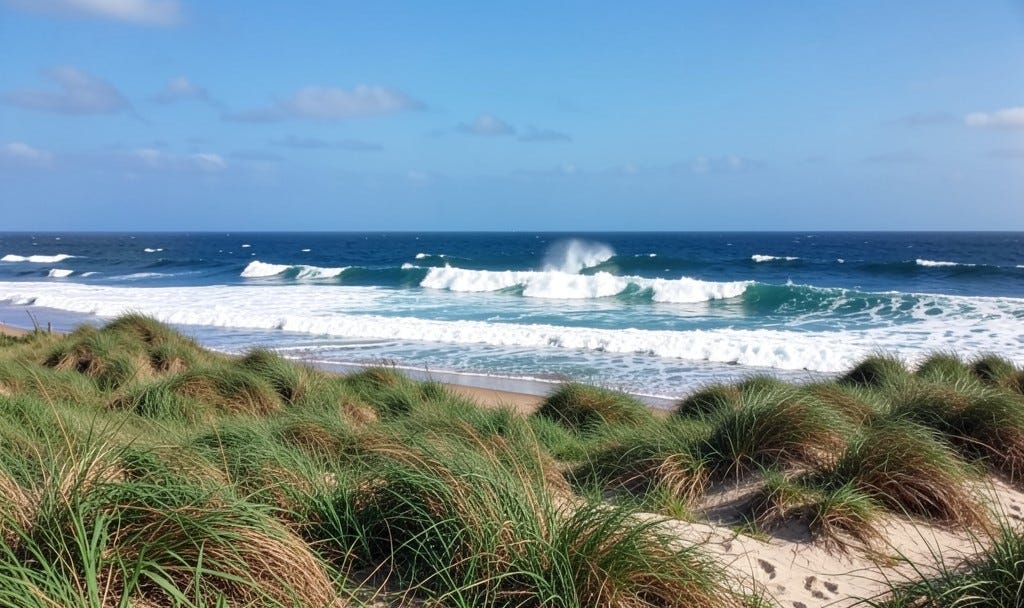
The tide is coming in. I’m perched in some grassy dunes watching the waves pound against the shore and eating from a bag of cherries I acquired on the way here. These are the good ones, Rainier cherries from Yakima Valley. They’re my favorite and they’re only in season for a brief time each year.
I’m enjoying the warmth of the late afternoon sun and the rhythm of the waves when a black Honda Civic comes spinning down the beach sending a huge flock of shorebirds into the air.
Windows down and music blaring, the occupants include a shirtless driver who appears to be in his late 30’s, someone in the passenger seat whom I can’t see, and a scruffy looking middle-aged man sporting a bright orange tank top who is hanging as far out the backseat window as he can get while whooping loudly over the music. The car is also loud as if the muffler has been removed or modified and it appears to have been lowered, which does not bode well for beach driving.
This section of Washington shoreline borders Native land and motor vehicles aren’t allowed, which is one reason I chose it. The summer crowds tend to congregate farther south where it’s legal to drive on the beach. Deep soft sand makes it tricky even for 4-wheel drive rigs, but there’s occasionally that one guy who has fallen prey to various substances and/or bravado and goes rogue.
This particular guy is breaking half a dozen laws and tacks on one more by fishtailing into a large donut before turning around and speeding past me again.
I’m far enough up in my grassy perch to avoid interaction, but a young woman walking her dog closer to the water isn’t so lucky. The driver pulls up next to her and Tank Top hangs out the window shouting commentary on her appearance. This isn’t likely to end well.

I spend a lot of time alone in the woods and mountains where there’s very little obstruction (people,) and mostly flow. It’s a sensory perception preference. Over the course of an average month in any season, wooded trails and subalpine lakes keep my senses straight.
I’ve been spending a lot more time in the Port Orford cabin on the Oregon coast, but even at home in the Washington mountains the pull toward sand and saltwater swells periodically, and I find myself heading west.
Oceanside has always been ground zero for me energetically.

A small pile of cherry pits accumulates on the sand by my feet as I ponder the term ground zero. It’s been kicking around in my brain for a while now.
The term originated in U.S. military jargon during the Manhattan Project in reference to the atomic bombings of Hiroshima and Nagasaki. That project produced the first nuclear weapons and helped end World War II, but it also opened the nuclear age.
Ground zero has, of course, since expanded beyond nuclear contexts to indicate the epicenter of any catastrophic event like earthquakes, tornadoes, air crashes, or battle zones where damage is greatest.
There are some obvious parallels here with the dismantling process.
The “self” you think you are is a fictional, egoic costume built from beliefs, fears, and borrowed ideas. To reach Human Adulthood you don’t try to heal or improve this self; it’s something that must be seen through and burned down, which can feel a lot like a catastrophic event.

I can hear the Honda spinning its wheels loudly in place down shore. They’re officially stuck and the tide is still coming in. I decide it’s safe to walk to the water’s edge and rinse the sticky cherry juice and sand from my fingers.
As I walk, I consider the more recent figurative use of ground zero as the starting point or very beginning of something. Back to ground zero.
Still fits. In fact, given the themes Tomas has been sharing lately from the portal archive, I can see how this new publishing format is itself a sort of ground zero.
The term is especially fitting for radical inquiry where the ability to ask a real question is essential and inevitably knocks you on your ass. In this sense, ground zero is the exact spot where dismantling the false self stops being an idea and starts being a lived, irreversible pivot toward authentic Human Adulthood.

Tomas is a Kiwi. I met him years ago in Auckland at one of the first talks I gave on the phases framework. He stayed in touch via email and was one of the early readers of the book manuscript before it was published. When Elaine was initially looking to bring on an admin for the questions portal Tomas threw his hat in the ring and I was delighted to have him come onboard. He’s intelligent, unassuming, and funny, with a keen eye for pattern recognition and a lived familiarity with the phases territory. His role has already evolved from one of admin into more of an editorial/research director.
Tomas plans to collect reader submissions (I think he’s calling them Field Reports,) to get a sense for the areas that are most valuable to explore here. It’ll take several months of gathering said submissions before new patterns emerge. In the meantime, he’s begun preparing editorial briefs drawn from the dominant patterns and themes in the portal archive.
This is exactly the type of structure I was wanting to keep things simple and flowing. His insights keep me engaged at a new level and will help ensure reader submissions are represented in the most useful way possible.
I’ll use Tomas’s editorial briefs to explore patterns and themes each month in several standardized formats, including deep dives, foundational essays, and monthly conversations between Tomas and me. Going forward, those conversations will round out the month and include opportunities to discuss things I’ve written about across each format.
However, in a few days we’ll kick things off with an inaugural conversation with Tomas so you can get to know him a bit. He’ll share his curation process, unpack some high level takeaways from the portal archive, and introduce the new method for reader submissions.
It should be good.
To be honest, all this wasn’t clearly indicated until rather recently. While I enjoyed aspects of the individual Q&A format of the portal, it wasn’t sustainable and ultimately became an energetic drain. Spending time with Tomas going over insights from the submissions helped me see places where most people are spinning their wheels, the foundational gaps in understanding, and the real value in pattern mapping. In other words, where most readers are, what’s keeping them stuck, and how to help orient more effectively.
Publications typically begin with the assumption that readers need more information, but this one assumes readers have already encountered the essential framework in the book and that what they need now is not more concepts but a place to repeatedly return as those concepts become lived experience.
A place to examine what becomes visible once the initial recognition has occurred and the old explanations no longer hold.
A kind of developmental ground zero.

I gather my pile of cherry pits (no choking birds on my watch,) and make my way back to the parking lot. About a quarter mile from the beach access point I pass by the Honda.
The State Patrol has arrived, and all occupants are out of the car, which is stuck and sinking rapidly into the wet sand. It’ll take a beach-rescue tow vehicle to get it out, assuming one arrives before the tide does.
A small crowd is gathering. One officer is speaking to the driver who is very animated in his communication, and another officer has Tank Top’s hands cuffed behind his back while he searches the interior of the car.
Whenever I see situations like this where lives unexpectedly change in a major way I always wonder if I’m witnessing a critical turning point, or transition. In this case there will be fines and penalties, possibly even incarceration depending on how things play out. Is this where Tank Top bottoms out? Is this someone’s catastrophic event?
And what about you?
I suspect many readers who arrive here after reading the book are in a place where the old architecture has failed. Maybe the assumptions that once organized your life are wearing thin, or the answers that once comforted you have begun to lose their authority. You may even feel as though something has gone terribly wrong, though I suspect the opposite.

Ground zero really is an apt metaphor, I think as I climb into my car. It’s not just the starting point of this publication, it’s also kind of like a field station built at the edge of a fault line. Not to prevent the earthquake, but to understand what it’s revealing. A place readers might return to each month to examine what the latest tremors have exposed.
Every meaningful journey has a point beyond which the old map is useless. Explorers know it. Scientists know it. Civilizations know it. The deconstruction of the juvenile self has one too, and that emptied, fractured place is its ground zero.
Not because everything ends here. Because nothing false survives.
Welcome.
